Battery chemistry is the single most consequential decision when you buy an electric golf cart. It determines not just the sticker price, but your maintenance schedule, downtime frequency, and the number of replacement battery purchases over the cart’s lifetime. This article breaks down both options across every cost driver that matters, so you can make a decision based on real numbers rather than sales talk.
Upfront Cost Comparison
There is no contest here on purchase day. Lead-acid golf carts cost significantly less at the point of sale.
A typical golf cart equipped with six 8V deep-cycle lead-acid batteries runs $2,000-4,000 for the battery pack alone. Add that to the base cart price and you have the most affordable entry point into electric golf cart ownership.
Lithium battery packs for the same cart class — think 48V/105Ah or 72V/150Ah — start at $5,000-12,000 depending on capacity and cell quality. The higher upfront cost is real and cannot be glossed over.
But upfront cost is only one data point. The full picture requires looking at what happens over years of ownership.
Lifespan and Cycle Count
Battery lifespan is measured in charge cycles — one full discharge followed by one full recharge equals one cycle.
Lead-acid batteries in golf cart applications typically deliver 300-500 cycles. With regular use — five to seven rounds per week — that translates to roughly 18 to 24 months before replacement is necessary. Heavy commercial use can shorten that window.
Lithium (LiFePO4) batteries deliver 2,000-3,000 cycles under the same conditions. At typical commercial usage rates, that is a lifespan of 8-10 years. Even in the most demanding fleet environments, a lithium pack will outlast the cart chassis that houses it.
The practical implication: lead-acid buyers will purchase two to four replacement battery packs over the same period where a lithium buyer makes none.
Maintenance Requirements
Maintenance is where the operational cost gap widens.
Lead-acid batteries demand regular attention:
- Water level checks every two to four weeks, with distilled water top-ups
- Terminal cleaning to prevent corrosion buildup
- Equalization charges monthly to prevent sulfation
- Load testing every three months to monitor capacity loss
All of this requires trained staff, scheduled labor hours, and distilled water supplies. In fleet operations, battery maintenance is a recurring line item in the operating budget.
Lithium batteries require no electrolyte management, no equalization, and no water. The maintenance task list reduces to:
- Visual inspection of connections and wiring every six months
- BMS self-diagnostics running continuously in the background
For fleet operators managing multiple carts, the labor savings from eliminating lead-acid watering rounds are substantial.
Charging Time and Efficiency
| Factor | Lead-Acid | Lithium (LiFePO4) |
|---|---|---|
| Full charge time | 8-12 hours | 4-8 hours |
| Charge efficiency | 75-85% | 95%+ |
| Partial charge effect | Memory effect risk | No memory effect |
| Charge-and-hold damage | Gradual capacity loss | No degradation |
Lead-acid batteries charge slowly and lose a meaningful portion of input energy as heat. A 48V/150Ah pack left on a standard charger overnight is the norm.
Lithium batteries accept charge at higher rates and with far less energy loss. A 48V/105Ah lithium pack on a smart charger typically reaches full charge in 4-6 hours. Partial charges do not reduce capacity — you can top up between rounds without concern.
For golf courses and resorts where carts are used during the day and returned in the afternoon, lithium’s fast charging window means carts can be fully ready for the next morning without an overnight charge.
5-Year Total Cost of Ownership
Here is where the numbers tell the real story. Below is a TCO model for a single golf cart over five years, using mid-range pricing in USD.
| Cost Category | Lead-Acid | Lithium |
|---|---|---|
| Battery pack (Year 1) | $3,000 | $8,000 |
| Replacement pack (Year 3) | $3,000 | $0 |
| Replacement pack (Year 5) | $3,000 | $0 |
| Maintenance labor (5 yr) | $1,500 | $200 |
| Water / supplies (5 yr) | $300 | $0 |
| Inefficiency losses (energy) | $500 | $100 |
| 5-Year TCO | $11,300 | $8,300 |
The crossover point — where the lifetime cost of lithium becomes lower than lead-acid — is typically 18 to 36 months depending on usage intensity. After that, lithium delivers pure savings.
For fleet sizes above five carts, the cumulative difference compounds quickly. A 20-cart fleet running lead-acid over five years costs roughly $60,000 more in battery-related expenses than the same fleet running lithium.
How RuiKe Builds Both Options
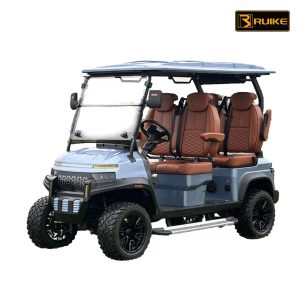
RuiKe GolfCart offers both battery chemistries across its full model lineup, so the choice is yours — and it does not lock you into a single supplier or configuration.
Lead-Acid Models
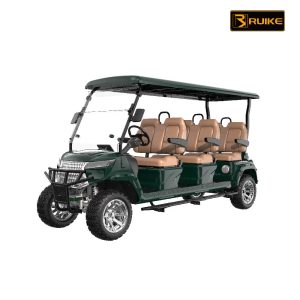
The Secolo series is the primary lead-acid platform. Configurations span 2-seat through 8-seat, with a standard 6-battery pack of 8V deep-cycle lead-acid delivering 80-100 km range per charge. The platform is well-proven, parts are globally available, and the total package cost makes it the most accessible entry point for buyers watching their initial outlay.
Lithium Models
The lithium program covers the broadest range of RuiKe’s lineup. Key examples:
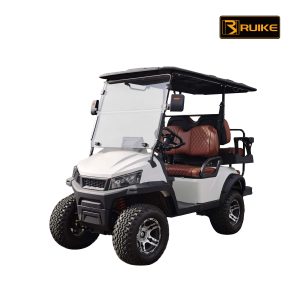
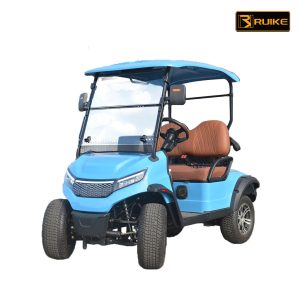
- Cooper and Kirin (2-seat): 48V/105Ah or 48V/150Ah lithium, 100 km range, 20% gradeability, DOT-certified tires, 4-wheel disc brakes
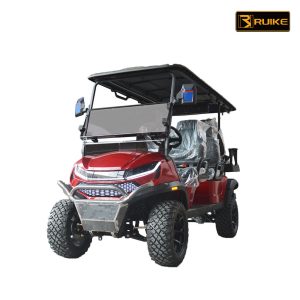
- Mammoth (2/4/6-seat): 48V/105Ah or 48V/150Ah lithium, 80-100 km range, 25% gradeability, built for off-road and elevated chassis configurations
- Blade/Edge (2/4/6-seat): 72V/150Ah lithium, KDS 7.5kW AC motor, 23-inch DOT tires, dual-circuit hydraulic brakes
- Rhino (4/6-seat): 48V/150Ah LiFePO4 with BMS and relay protection circuit, 80 km range, 20% gradeability
- Knight (4/6-seat): MAHLE 48V/5kW AC motor, Bluetooth FJ controller with downhill trailer brake and auto-slip prevention, 25% gradeability
All RuiKe lithium packs use LiFePO4 chemistry — the safest and most cycle-stable lithium variant for golf cart applications. Cell-level battery management systems (BMS) handle cell balancing, over-charge protection, and thermal monitoring automatically.
Get a Lithium Golf Cart Quote
The math over five years favors lithium for almost every commercial use case. The upfront premium pays back within two to three years, and from that point forward the savings are pure.
RuiKe ships lithium and lead-acid carts to 78 countries with full documentation, battery certifications (KC/UL38.3/MSDS), and dealer support.
Request a quote for lithium or lead-acid golf carts — tell us your seat count, terrain, and annual volume, and we will put together a configuration that fits your budget and your fleet schedule.
Frequently Asked Questions
How long do lithium golf cart batteries last?
Lithium (LiFePO4) golf cart batteries last 8-10 years with daily use, delivering 2,000-3,000 charge cycles. Lead-acid batteries typically require replacement every 18-24 months under the same conditions.
Can I upgrade my lead-acid golf cart to lithium?
Yes. Most electric golf cart models can be retrofitted from lead-acid to lithium batteries, provided the battery compartment accommodates the new pack dimensions and the charger is replaced with a lithium-compatible unit. RuiKe offers lithium upgrade packs for most models in the lineup.
Is it safe to leave a lithium golf cart battery charging overnight?
Yes. LiFePO4 batteries used in RuiKe carts include a Battery Management System (BMS) that automatically terminates charging when the pack reaches full capacity. Unlike lead-acid, there is no risk of overcharging or thermal runaway under normal charging conditions.
Do lithium golf carts get enough range for an 18-hole course?
Yes. A 48V/105Ah lithium pack delivers 80-100 km of range, which covers two full rounds of golf on a standard course with power to spare for headlights and accessories. The Cooper and Kirin models with 48V/150Ah lithium push beyond 100 km per charge.
Why do golf carts still use lead-acid batteries?
Lead-acid remains common because of lower upfront cost and well-understood technology. For low-frequency personal use — a few rounds per week on a private property — a lead-acid cart is still a reasonable choice. For commercial fleets, resorts, or daily-use operations, the math increasingly favors lithium.
How much can a fleet save by switching from lead-acid to lithium?
A 20-cart fleet switching from lead-acid to lithium saves approximately $60,000 in battery-related costs over five years. Beyond battery costs, fleet operators save on maintenance labor, water supplies, and downtime from carts out of service for battery maintenance or failure.