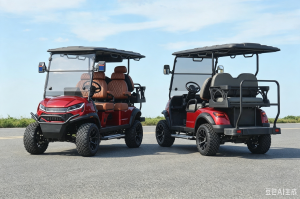
 Understanding Golf Cart Seat Capacity
Choosing between a 4-seater and a 6-seater golf cart sounds simple. It is not. Get it wrong and you either cram passengers into a cramped vehicle or waste money on seats that sit empty round after round. This guide breaks down every factor that matters for your operation.
When to Choose a 4-Seater Golf Cart
A 4-seater golf cart works best when efficiency and maneuverability drive your decision. Here is where it makes sense:
Golf Courses with Tight Fairways
Narrow fairways, dense tree lines, and sharp doglegs punish larger vehicles. A 4-seater typically measures around 110 inches long, compared to 130+ inches for a 6-seater. That difference matters on a course where you are navigating between sand traps and water hazards every three holes. Shorter wheelbase also means a tighter turning radius, letting drivers complete a U-turn without reversing.
Cost-Sensitive Operations
A 4-seater has a lower purchase price and lower operating cost. You pay less upfront, spend less on battery charging per cycle, and face smaller replacement tire bills. For a small golf course or a club with a tight maintenance budget, that gap compounds over a fleet lifecycle of five to eight years.
Faster Turnaround Between Rounds
Lighter vehicle, smaller battery pack, less mass to accelerate and brake. On courses running high tee-sheet utilization, a 4-seater gets back to the clubhouse faster. That matters when you are running 90-second intervals on a Saturday morning.
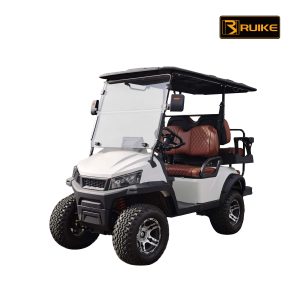
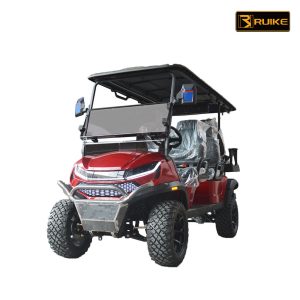
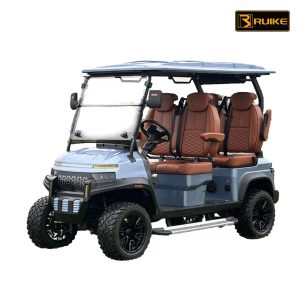
RuiKe 4-Seater Models
RuiKe GolfCart offers three 4-seater configurations:
- RG-C4S: Standard 4-passenger, lead-acid battery, ideal for daily-fee courses
- RG-C4L: 4-passenger with lithium battery upgrade, extended range up to 80 miles
- RG-C4LX: 4-passenger luxury edition with premium seats, DOT tires, and full LED lighting
When to Choose a 6-Seater Golf Cart
A 6-seater solves a different problem. It is not about replacing two 4-seaters. It is about serving venues where groups move together and space is available to accommodate them.
Resorts and Hotels
Large resort properties use golf carts as on-site shuttles. Guests want to ride together as a group from the lobby to the beach club, the spa, or the golf range. A 6-seater eliminates the need for multiple vehicles for one family or group. The operational saving is not just in carts owned but in driver time and parking congestion at multiple stops.
Retirement Communities
Retirement communities and residential estates with wide internal road networks are a natural fit for 6-seaters. Residents often travel in pairs or small social groups. Six seats mean the HOA can deploy fewer carts on a given route while maintaining the same passenger throughput. Accessibility ramps and low-step entry on models like the RuiKe RG-C6L make them suitable for residents with mobility considerations.
Event Venues and Tours
Wedding venues, winery tours, and large outdoor event spaces use 6-seaters as guest transport. The open-air configuration lets groups sightsee together, take photos, and move as a social unit. RuiKe’s RG-C6LX with canopy option provides weather protection while maintaining the open-air feel guests expect at outdoor venues.
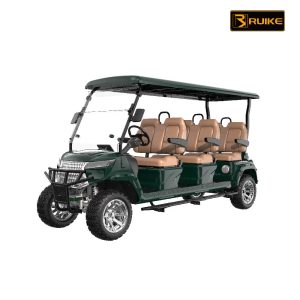
RuiKe 6-Seater Models
- RG-C6S: Standard 6-passenger, lead-acid, high floor clearance for varied terrain
- RG-C6L: 6-passenger lithium edition, up to 70 miles range per charge
- RG-C6LX: 6-passenger luxury with extended canopy, USB charging ports, and premium upholstery
Side-by-Side Technical Comparison
The table below summarizes the core technical differences that drive operational decisions.
| Specification | 4-Seater Golf Cart | 6-Seater Golf Cart |
|---|---|---|
| Overall Length | 110 inches (2,800 mm) | 132 inches (3,350 mm) |
| Overall Width | 48 inches (1,220 mm) | 48 inches (1,220 mm) |
| Wheelbase | 68 inches (1,730 mm) | 84 inches (2,135 mm) |
| Turning Radius | 12.5 feet (3.8 m) | 15.5 feet (4.7 m) |
| Motor Power | 3kW – 5kW | 4kW – 7.5kW |
| Lead-Acid Range | 40 – 50 miles | 35 – 45 miles |
| Lithium Range | 60 – 80 miles | 55 – 70 miles |
| Max Payload | 600 lbs (272 kg) | 800 lbs (363 kg) |
| Estimated Price Range | $4,500 – $8,500 | $6,500 – $12,000 |
| Best Use Cases | Golf courses, small clubs, tight courses | Resorts, retirement communities, event venues |
Making the Decision for Your Operation
There is no universally correct answer. The right choice depends on three variables:
1. Primary Use Environment
If your primary users are golfers on a traditional course, a 4-seater is almost always the right starting point. If your primary users are resort guests, tour groups, or community residents, a 6-seater reduces vehicle count and improves guest experience.
2. Site Constraints
Measure your tightest turn, your narrowest gate, and your lowest clearance. A 6-seater needs roughly 25 percent more turning radius. If your site has tight corners, a 6-seater will create operational headaches that outweigh its passenger capacity advantage.
3. Budget and Fleet Size
Two 4-seaters cost more than one 6-seater with equivalent passenger capacity. But two 4-seaters provide redundancy. If one breaks down, you still have one operational unit. If your 6-seater goes down, you lose transport for six. For critical-use operations, fleet redundancy is worth the premium.
FAQ: 4-Seater vs 6-Seater Golf Cart
Can a 6-seater golf cart be used on a golf course?
Yes, but it depends on the course layout. Most championship and resort courses accommodate 6-seaters. Tight, tree-lined courses may restrict larger carts due to the wider turning radius. Check with the course superintendent before adding 6-seaters to a golf fleet.
What is the maintenance difference between 4-seater and 6-seater carts?
A 6-seater has more components to maintain: larger battery pack, more tires, higher-capacity brakes. Annual maintenance costs for a 6-seater run approximately 20-30 percent higher than a comparable 4-seater. Budget accordingly during fleet planning.
Do 6-seater golf carts need a special license?
In most US states, golf carts operated on private courses or designated golf cart paths do not require a driver’s license. Some jurisdictions require registration for carts used on public roads at speeds above 20 mph. Check your local DOT regulations, especially for resort and community applications.
How long does a lithium battery last in a golf cart?
A quality lithium battery pack (such as RuiKe’s LiFePO4 cells) delivers 2,000 to 3,000 charge cycles before dropping to 80 percent capacity. At four to five cycles per week, that translates to 8 to 15 years of useful life, compared to 3 to 5 years for a lead-acid battery pack.
Can I mix 4-seater and 6-seater carts in one fleet?
Yes, and many large operations do. Use 4-seaters for early-morning tee times and peak-demand periods on the course. Deploy 6-seaters for afternoon resort shuttles, event transport, and community use. A mixed fleet gives you flexibility without overcommitting to one vehicle type.
What customization options are available for RuiKe golf carts?
RuiKe offers full OEM customization across both configurations: custom colors and branding, canopy and weather enclosure options, DOT-certified tire upgrades, lithium battery upgrades, USB charging ports and accessory outlets, rear cargo beds for utility use, and digital displays with fleet management integration. MOQ for OEM orders is 5 units per configuration.